Saturday, July 23, 2016

Former French Homes

In the early 1900's when I suspect these French homes were built, the French colonial government was in full swing.  French high society lived in these homes.  They were either linked to the government or they owned a rubber plantations or maybe they owned paddy fields for growing rice.  World War II was the beginning of the end for them when the Japanese threw the French out of Vietnam during the war.  By 1970, when I arrived, the French were long gone.

You can see that the fences hadn't had paint in a long time.  That bird house in the snapshot below must have cost a fortune to build in its time.  It was wasting away.  I noticed that windows were open in a few places.  I believe that caretakers were living in the homes.

I checked on the internet and could not find any indication that these houses still exist.  It wouldn't surprise me if they were torn down by the communists from North Vietnam when they took over the South in 1975.  They wouldn't have liked them because they represented a former colonial power who in their mind lived high while the population suffered.  Besides, who could have afforded to fix them up and live in them again.

It amazes me how quickly a country can change as conquerors come and go.  What did this location look like before the French and what must it look like now.  Maybe some day I will get over there and see for myself.    

Tuesday, July 12, 2016

First Team Academy

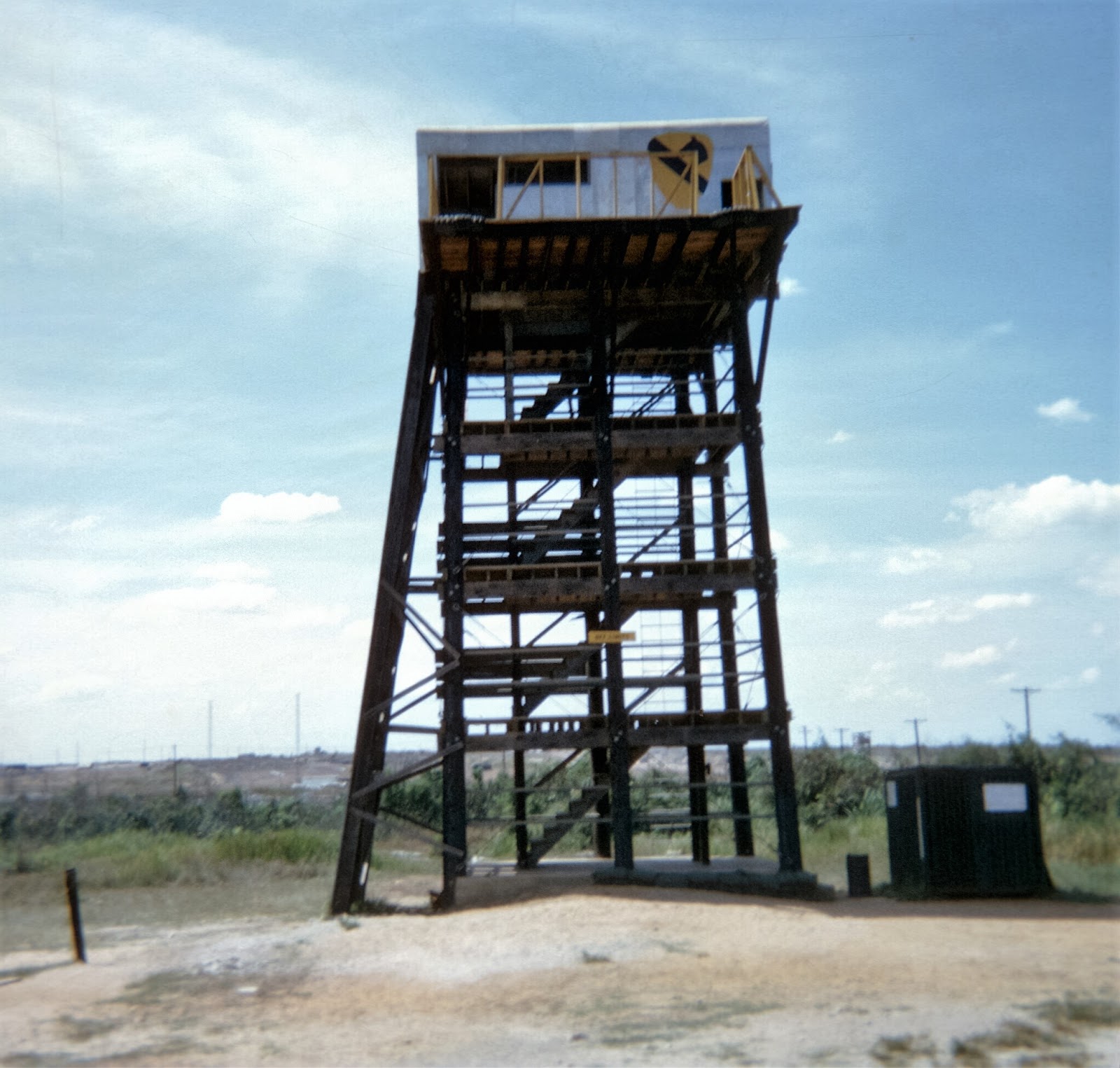
The First Team Academy is where the First Cavalry Division sent recruits who had just arrived from the United States.  A busload of us  spent a week there training in the hot sun as a way to get used to the climate.

I like it there for a lot of reasons.  I felt like I was finally moving forward rather than hanging around waiting to be assigned to a unit.  The conditions were better.  We received three good meals a day and slept on a bed that felt reasonably clean.  We learned a lot more about how to fight in the villages and jungles of Vietnam.  The highlight of the place however, was the repelling tower that you can see in the snapshot below.

Repelling was the art of leaping from a hovering helicopter to the ground below by sliding down a rope using a D-Ring as a brake.  Instructors told us that we may have to repel from a helicopter if the pilot could not set down on the jungle floor for some reason.

To practice, they had us repel from the platform you can see at the top, down forty feet to the ground below.  We first learned how to belt ourselves into a body harness then connect a rope to the harness with a D-Ring.  To ensure that the training would be a hair-raising experience, instructors forced us to jump of the end of the platform with enough slack in the rope to free-fall about ten feet before being jerked to a stop.  Then we lowered ourselves to the ground using the D-Ring.

Throwing yourself of the platform rather than crawling over the edge was meant to be part confidence building, part sadistic.  The fear I felt before the leap quickly changed to a feeling of pride as I lowered myself to the ground.

Time went by quickly at First Team Academy because they kept us busy.  Much too soon, we received our orders for the next leg of our tour of Vietnam.  

Tuesday, July 5, 2016

Bien Hoa Air Base

The French built Bien Hoa Air Base in 1955 for the First Indonesian War.  The United States shared the Air Base with the South Vietnamese during the Vietnam War that followed.  So when I landed in a Freedom Bird at Bien Hoa Air Base in January 1970, the base had been in existence for fifteen years and it showed. (Freedom Bird was the name given to the commercial jets that carried American soldiers to Vietnam from the United States.)

I was shocked how large the base was and how ordinary it felt.  It could have been any other Air Base in the United States.  Stepping off the plane in Vietnam for the first time and then seeing that sign, left me feeling that maybe Vietnam was not going to be so bad after all.

During my tour in Vietnam, I returned to Bien Hoa Air Base many times.  Every few months we flew to Bien Hoa when traveling to in-country R&R (Rest & Recuperation) sites for a three-day break from the action.  When I went on a one-week R&R to Japan and then months later to Australia, I flew into Bien Hoa.  I took combat leadership training in the Bien Hoa area.  Bien Hoa was a destination for me that always meant that I would be out of the fighting for awhile.

That blurry snapshot to the right is Bien Hoa Air Base taken from the air.  I took the picture at the end of my tour.  I had been released from the First Cavalry Division and had my orders to return to the United States.  I waited three agonizing days to get a seat on a Freedom Bird.  They bused me and a plane-load of others to a set of stairs at Bien Hoa Air Base that lead up to the open door of the airplane.  I was lucky enough to to get a window seat.  We taxied to the runway, took off, and then banked right.  As we turned, I could see Bien Hoa Air Base below.  Leaning toward the window and looking down thorough my Instamatic Camera view finder, I snapped my last picture of Vietnam.  It felt like I had just closed a door.  I knew I would never have to come back again.  It felt so good to take that picture.

Monday, June 27, 2016

Jungle Landing Zone

Here we are approaching a landing zone in the jungle.  The military term for this kind of action was a Combat Assault.  Anxiety would normally be cranked up but not this time because we were second-in.  That is why I risked having my camera out.

The door gunner on my right has his M60 machine gun up and ready to use.  You never know what will happen when landing in the jungle.  Ammunition for the M60 was feed from the metal box you can see just below the gun.  See that red ring on the front of the box?  That is the top of a smoke grenade.  We used smoke grenades in colors like red, yellow, blue and green to mark landing areas in the jungle.

In the snapshot below you can see an officer and a sergeant having a discussion on the jungle floor.  They were on the first-in helicopter.    They are deciding how to set up the perimeter.  We always set up a perimeter around the landing zone to protect the helicopters that were still landing.    That is my knee in the lower right corner of the picture.

Approaching a landing zone in the jungle by helicopter was about the most dangerous thing we did.  We were like sitting ducks.  For the enemy, we were a clear and open shot.  We would fly slower and slower as we dropped in so we were an easy target to hit.  If they started firing at us, we couldn't accelerate out of there very quickly.  The reaction time of a Huey helicopter is slow.  If the pilot was hit, the helicopter could easily lose control and spin into the ground.  So with all of those possibilities, it was a tremendous relief when you jumped off, ran to the perimeter, got down on your knees, faced your M16 toward the jungle and waited for the remaining helicopters to land.

If the whole company was landing, there would be about three waves of five helicopters coming in one after another.  I can't imagine what the enemy thought if they were within a kilometer of a landing site.  All that noise disrupting their quiet space.  If I was them I would have have been tempted to run in another direction.  


Wednesday, June 22, 2016

Traveling By Huey

Two similar snapshots.  I'm sitting on the floor in the doorway of a Huey helicopter.  Across the way is another Huey flying along with us in formation.  Usually there were five of them flying together.

If you look closely at the other helicopter, you can see someone sitting in the same place I am sitting with his feet dangling in the breeze.  He is a lot closer to us than it looks.  I could almost yell hello to him over there if it wasn't for the noise from the helicopter's jet engine and the blades beating the air above.

 On my right, is an M60 machine gun.  It is held in place by a gun mount that allows it to be pointed in any direction.  Linked 7.62 mm ammunition with tracer rounds are fed into the side of the gun and ready to shoot.  The door gunner sits above and to my right on a webbed chair behind the gun.  He is relaxed and I am relaxed for the moment.  We are both looking out at the landscape below.  We cannot get in trouble when we are cruising along at 80 knots and 2,000 feet in the air.  Enemy soldiers are not going to shoot at us this high up.  They will wait until we drop lower where we are a much larger, slower, and easier target to hit.

When we traveled like this, we were either on the way in or on the way out of the jungle.  If on the way in, we would be enjoying the view while at the same time wondering what the landing zone in the jungle will be like.  Most times, the landing zone would not have enemy soldiers waiting there for us.  The reason was they had no idea what particular open spot in the jungle the helicopter would choose to drop us in.  They didn't have enough soldiers to cover every clearing out there so most times a landing in the jungle was uneventful.

If we had just been picked up from the jungle, we would be feeling relieved.  We knew we were heading to hot showers, hot meals and clean clothes on a firebase somewhere.  So we just sat back and enjoyed the ride.  Yes, we would have to pull guard in the evening on a firebase, but the days would be spent relaxing and reading for the most part.  We could wind down a bit.  As you might imagine, I enjoyed leaving the jungle a hell of a lot more than returning to it.    


Tuesday, June 14, 2016

Huey Helicopters

The Bell UH-1 Iroquois, widely known as a Huey by the Grunts in Vietnam, were primarily used when traveling to and from the jungle.  We traveled in them so much that we all earned Air Medals.

The Army had other uses for Huey's as well.  They used them as medivac helicopters,  They would swoop in and extract wounded soldiers from the jungle then deliver them to a hospital.   They installed all kinds of weaponry on them, such as mini-guns and rocket pods, then used them as attack helicopters.  They were used to supply us with food and water every three days while we were in the jungle.

It didn't surprise me when I read that the Army used over 7,000 of them in Vietnam.  What first impressed me about them was a Huey was powered by a turbojet engine.  Until I saw my first Huey, I thought jet engines were all used to push an aircraft like a rocket.

As a troop carrier, it was amazing how many guys they could transport.  The crew consisted of a pilot, co-pilot and two door gunners.  The door-gunners sat on each side toward the rear.  If you look closely at the picture above, you can make out the M60 machine gun they used.  There was an M60 on each side.  Behind the pilots was space for about eight soldiers, each with their own pack and weapons.  When you consider that a pack alone weighed about eighty pounds, it is hard to believe that a Huey could actually fly with all of that weight.

To help save weight and simplify getting in and out of a Huey, the doors were removed.  Everywhere we flew, we flew with no doors.  A prized place to sit was on the floor where the door would normally be with your feet dangling out over the struts.  We held on for dear life, believe me, but it was a rush.  You probably think that it was a scary experience flying like that.  When we would first take off, I would feel a flutter in my stomach as we passed low over the jungle.  But once we were up over a thousand feet, the flutter disappeared and I enjoyed looking down at all the greenery that passed below.


Friday, June 3, 2016

Having Some Fun


My book, "21 Months, 24 Days" has a whole chapter about these snapshots.  What you are looking at is the bottom of a Huey helicopter with three soldiers dangling from it.  I was one of those soldiers!  That day was maybe the craziest day of my life.

When we are young, a lot of us take risks on a dare or just for the thrill of it.  Some take a day and learn to parachute from an airplane.  Some climb rock walls hundreds of feet high.  Some take dangerous rafting trips on wild river rapids.  Others bungee jump from bridges.  In this case, I didn't get pushed into it on a dare.  Nor did I do it because of the thrill.  I did it because I thought I was going to die anyway over there so why not.

What you see in the picture was part of a fifteen minute thrill ride.  The ride began when we stepped into the harness.  The harness was formed into a simple loop that we tucked under our ass like a kids swing.  The helicopter was hovering one-hundred feet over our head, waiting for our signal.  When ready, with nothing more than a thumbs-up, the pilot began to rise straight up until we were about 750 feet in the air.  Then he tipped the main rotor forward while increasing the pitch of the blades and we found ourselves accelerating forward while continuing to rise.  Before you knew it, we were flying at an elevation of 1,500 feet and traveling forward at 80 knots.  Air resistance swung us back behind the helicopter so when you looked up, the helicopter was actually out in front of us.  In that position we cruised over the countryside.  Thankfully, we were out of range from enemy rifle fire below.  Too soon, we were back to where the ride began and then lowered to the ground.

Well that is enough about what we did.  You will have to read the book to learn why the ride was offered to us in the first place.